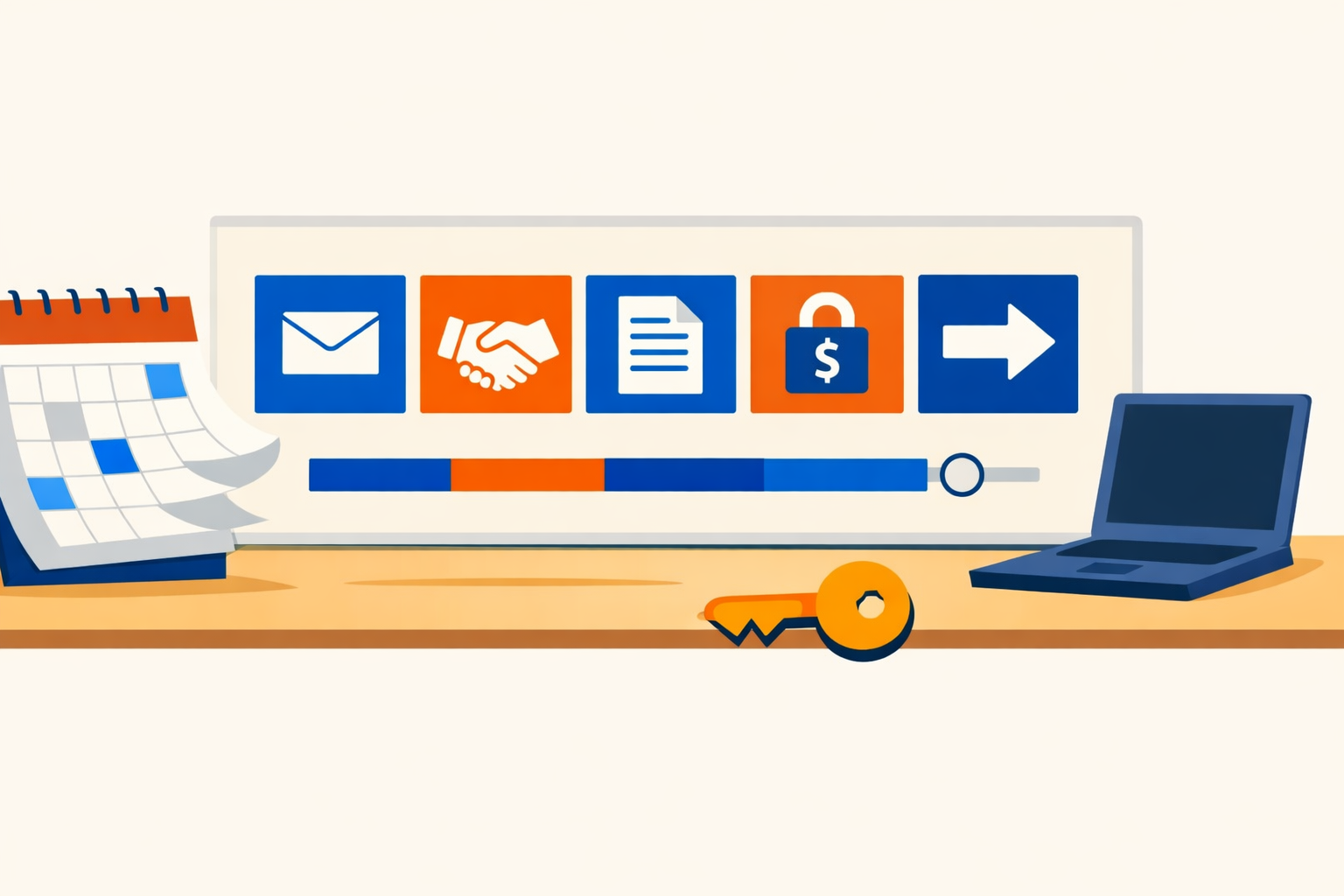
Domain Acquisition Timelines: How Long Does It Actually Take to Buy a Taken Domain
Buying a domain that is already owned rarely follows the neat, same-day checkout flow people expect from registrars. A real acquisition has human latency, competing priorities, legal review, payment logistics, and transfer mechanics, all stacked on top of the owner’s willingness to sell. A realistic domain acquisition timeline is measured in days or weeks for straightforward deals, and months for complex ones.
This article breaks down how long to buy domain assets that are taken, from first contact through transfer, using the variables that actually move timelines: owner type, responsiveness, price expectations, corporate process, and technical constraints.
The three forces that determine timeline (more than price does)
Speed depends on three things that show up in almost every deal: whether you can reach the right person, how quickly both sides can agree on terms, and how cleanly the domain can be transferred.
Owner reachability is the first gate. If the WHOIS is privacy-protected, the domain is held at a large portfolio company, or the domain sits inside a corporation with no obvious point of contact, you can lose a week before a real conversation even starts.
Negotiation pace is the second gate. Domain negotiation duration is driven by response time and decision structure, not by how persuasive your message is. A solo founder who checks email daily moves faster than a brand department that needs approvals, vendor onboarding, and procurement.
Transfer readiness is the third gate. Even after a price is agreed, the fastest transfer only happens when the seller has registrar access, can unlock the name, can provide the authorization code, and can handle escrow or invoicing without internal friction.
The best predictor of timeline is responsiveness plus authority. If the person replying cannot say “yes” without approvals, expect weeks, not days.
A practical domain acquisition timeline, end to end
Most acquisitions follow the same stages. The variance is how long each stage takes.
Stage 1: Identify ownership and the right contact (same day to 10 days)
A serious acquisition starts with confirming who controls the domain and how to reach them. Use a WHOIS record and historical signals (landing pages, portfolio listings, DNS, and prior sales behavior) to avoid wasting time.
If you are starting from scratch, run the domain through a lookup tool such as WHOIS Lookup to see registrar, nameservers, and any available contact path. When privacy is enabled, the next step is often indirect outreach via privacy email relay, contact forms, LinkedIn, or corporate directories.
Typical time ranges:
- Public WHOIS, direct email works: 0 to 2 days
- Privacy relay or contact form only: 2 to 7 days
- Corporate ownership with no clear owner: 5 to 10 days
Time killers at this stage:
- Outdated WHOIS email forwarding that silently fails
- Parked pages with no contact mechanism
- Domains held by entities that do not monitor inbound inquiries
Stage 2: First outreach to first real reply (1 day to 3+ weeks)
This is where most timeline estimates break. You can send an email in five minutes, but you cannot control when, or if, the owner responds.
Typical time ranges by owner type:
- Active operator using the domain for a business: 1 to 7 days
- Investor with a sales inbox or “for sale” page: 1 to 5 days
- Corporate owner, domain not in active use: 1 to 3 weeks
- Abandoned asset, inactive owner: 2 weeks to never
A fast acquisition often depends on getting a “yes, I’m open to selling” quickly, even if price is not discussed yet. If you do not get that signal, you are in a chase scenario and should plan accordingly.
Stage 3: Price discovery and term alignment (2 days to 6+ weeks)
Once the owner engages, the deal moves into value and terms. This is the part most people mean when they ask how long to buy domain assets that are taken. In practice, the negotiation itself can be short, but the back-and-forth cycles add up.
Common patterns:
- Investor-owned domains: usually quicker pricing, fewer stakeholders
- Operating business domains: more emotional attachment, brand risk concerns, replacement planning
- Corporate portfolios: slower approvals, sometimes fixed pricing frameworks
Typical time ranges:
- Investor with clear price expectations: 2 to 10 days
- Small business using the domain: 1 to 4 weeks
- Enterprise or public company: 3 to 8 weeks
Factors that extend domain negotiation duration:
- Seller anchors to unrealistic comps and needs time to recalibrate
- Buyer has internal budget gates and keeps “checking internally”
- Seller requests proof of funds, identity verification, or contract language
- Parties disagree on payment rails (wire, escrow, invoicing)
If you need a sanity check on pricing before you move to paperwork, an estimator can help frame ranges. BrandHunt has a Domain Appraisal tool that can be used for a ballpark reference, especially when you are comparing options.
Stage 4: Paperwork, escrow setup, and payment logistics (1 day to 3 weeks)
Even simple deals can stall here. The buyer is ready, the seller is ready, but the mechanics are not.
Fast paths:
- Standard escrow platform, both parties familiar
- Wire transfer with immediate confirmation
- Seller is an individual with direct control of the domain
Slow paths:
- Seller requires an MSA, NDA, or custom purchase agreement
- Buyer is a company that requires vendor onboarding and tax forms
- Seller is a company that requires invoicing with net terms
Typical time ranges:
- Simple escrow transaction: 1 to 5 days
- Invoicing and corporate procurement: 1 to 3 weeks
Stage 5: Domain transfer execution (same day to 14 days)
Transfers can be fast, but they are not always instant. The method matters.
Two common transfer routes:
- Push within the same registrar: often same day once the seller initiates
- Inter-registrar transfer: typically several days, sometimes up to a week depending on verification and registrar policies
Constraints that add time:
- Domain is locked or the seller cannot access the account
- Two-factor authentication issues or old accounts
- Domain within 60 days of registration or a recent transfer (ICANN transfer restrictions)
- DNS dependencies that require coordinated cutover
If you want the mechanics laid out step-by-step, BrandHunt’s Domain Transfer Guide covers the practical sequence and common pitfalls.
Stage 6: Post-transfer validation (same day to 3 days)
A professional acquisition does not end when the domain arrives in your account. You should confirm:
- Registrar account ownership and correct contact details
- Lock status and renewal settings
- DNS resolution and SSL certificate impact
- Any redirects or email routing that need to be replicated
Typical time: same day to 72 hours, depending on DNS propagation and deployment schedules.
Timeline ranges by owner type (what to expect in the real world)
Different sellers behave differently. If you are estimating a domain acquisition timeline, start with owner type.
Investor-owned domains (7 to 21 days typical)
Professional domain investors tend to be reachable and accustomed to escrow, which compresses the process. Pricing can still be aggressive, but the steps are familiar.
Common timeline profile:
- Contact and reply: 1 to 5 days
- Negotiation: 2 to 10 days
- Escrow and transfer: 2 to 7 days
Total: often 1 to 3 weeks.
Small business operators (2 to 8 weeks typical)
A business that actively uses the domain has operational risk in selling it. They may need to secure a replacement domain, plan a rebrand, or coordinate marketing and email migration.
Common timeline profile:
- Contact and reply: 2 to 10 days
- Negotiation: 1 to 4 weeks
- Logistics and transfer: 3 to 10 days
Total: often 2 to 8 weeks.
Enterprise and corporate portfolio owners (4 to 12+ weeks typical)
Corporations can be slow even when they are willing. Approvals, legal review, and procurement add calendar time. Sometimes the person replying is not the person who can execute the transfer.
Common timeline profile:
- Finding the right owner: 1 to 3 weeks
- Negotiation and approvals: 3 to 8 weeks
- Contracting and payment: 1 to 3 weeks
- Transfer execution: 3 to 10 days
Total: often 1 to 3 months.
Inactive owners and abandoned domains (unbounded)
Some domains are controlled by people who have moved on, changed emails, or simply do not care. If you cannot establish contact, there is no reliable timeline. In these cases, you either keep trying via alternate channels, pursue a different name, or monitor for expiration and drops.
Complexity tiers: what “fast” and “slow” actually look like
A deal can be fast even at a high price, and it can be slow at a modest price. Complexity is the determinant.
Tier 1: Clean, friendly transaction (3 to 10 days)
These are the best cases.
- Seller replies quickly
- Price expectations are reasonable
- Domain is at a major registrar with easy push
- Escrow is accepted without custom contracts
You will still spend time waiting for escrow milestones and transfer confirmation, but the process is straightforward.
Tier 2: Normal negotiation with a few wrinkles (10 to 30 days)
This is the median for many acquisitions.
- A few negotiation rounds
- One party needs internal sign-off
- Transfer is inter-registrar
- DNS coordination is required
Tier 3: Corporate or operationally sensitive sale (30 to 90+ days)
This tier is where timelines stretch.
- Multiple stakeholders and approvals
- Legal review, sometimes contract redlines
- Seller needs time to plan a migration off the domain
- Payment requires invoicing, compliance steps, or vendor onboarding
The hidden timeline killers (and how to reduce them)
Certain issues repeatedly add weeks. Planning around them is the difference between a realistic schedule and a missed product launch.
Waiting for replies without a follow-up system
A single email and a hope is not a process. Set a follow-up cadence, use multiple channels where appropriate, and keep messages short and specific. If you do not have a reply after two weeks, assume the current path is not working.
Budget ambiguity on the buyer side
If the buyer cannot commit to a range, negotiations drag. Sellers read hesitation as a signal to hold firm or stop replying. Even a non-binding range speeds up the conversation.
Procurement and legal review that starts too late
If you are a startup buying through an entity with procurement steps, start those steps early. If you are an enterprise buyer, assign a legal contact before the seller asks for paper.
Transfer restrictions and account access problems
A surprising number of sellers do not have clean access to the registrar account, especially when the domain was registered years ago by a former employee or an agency.
Before you assume a transfer can happen next day, confirm:
- Seller has registrar login access
- Domain is not within the 60-day transfer restriction window
- Domain can be unlocked and an auth code can be generated
Planning your launch around a domain acquisition
Launch schedules and domain purchases collide most often when teams treat the domain as a late-stage checkbox. A taken domain should be treated like a dependency with an uncertain lead time.
A practical planning model looks like this:
- If you need the exact .com for launch: start outreach 8 to 12 weeks ahead
- If you can launch on an alternate and upgrade later: start outreach 2 to 6 weeks ahead and keep a backup live
- If the domain is owned by an enterprise: assume 2 to 3 months and plan contingencies
Two-track planning is standard for serious teams. Secure a usable domain for the launch, then run acquisition in parallel for the ideal name.
One question to ask early: “Can you transfer this domain this week if we agree?”
A single operational question can expose whether you are heading toward a fast close or a slow one. If the seller hesitates, expects someone else to handle it, or cannot identify the registrar, you should assume delays.
That question also changes behavior. Sellers who are serious will check access, confirm registrar details, and prepare for the mechanics. Sellers who are not serious will drift.
The calendar risk in acquisitions is rarely the negotiation itself. It is everything that happens after the handshake.
A simple checklist to keep timelines tight
Use this to reduce avoidable delay:
- Confirm ownership and registrar early via WHOIS Lookup
- Establish your budget range and approval authority before negotiating
- Ask the seller what transfer method they prefer (push vs transfer)
- Agree on escrow or payment rails before you spend weeks debating price
- Validate transfer eligibility (no recent transfer, domain unlocked, auth code available)
- Coordinate DNS cutover plan so the domain does not go dark after transfer
Next step: pick the right name, verify ownership, then acquire it the right way
A realistic domain acquisition timeline starts with choosing a name you can defend, then confirming whether the domain is actually obtainable on your schedule. Brainstorm alternatives with the Domain Generator, verify ownership and registrar details with WHOIS Lookup, and sanity-check pricing expectations with the Domain Appraisal.
If the domain you want is already taken and timing matters, BrandHunt.com helps companies acquire domains that are owned by someone else. When you are ready to pursue the exact name, use our Contact Us page and we will run the outreach, negotiation, and transfer process with a timeline you can plan around.