Why Some Domains Cost $500 and Others Cost $50,000
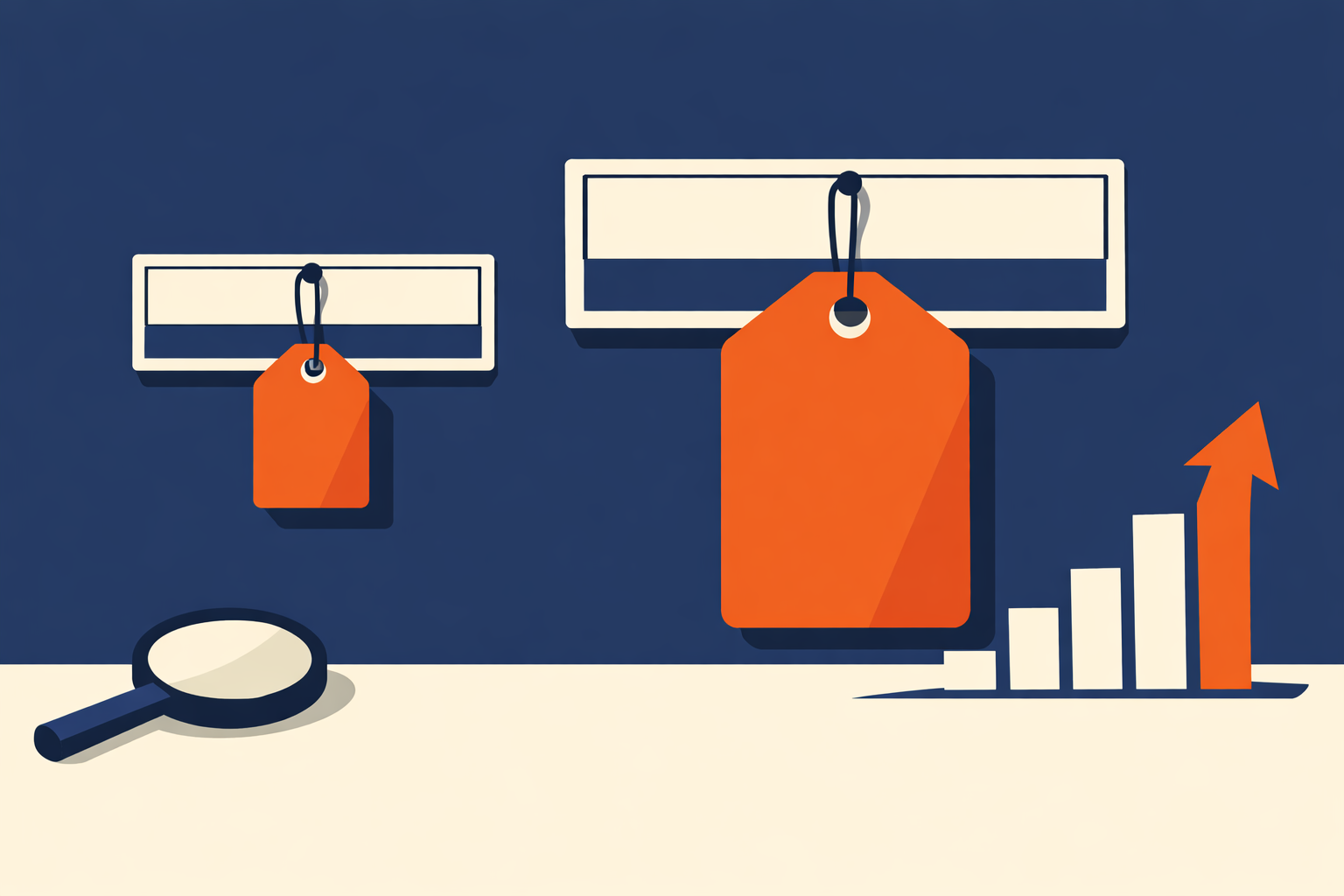
A $500 domain and a $50,000 domain can look almost identical in a search bar. Same extension, similar length, both available for transfer today. The price gap usually comes from one thing: how much commercial demand already exists for that exact string, and how hard it is to replace without taking a branding hit.
Domain pricing is not random, and it is not purely “what someone feels like charging.” There are repeatable domain pricing factors that push certain names into five figures while others struggle to clear four.
Domains are priced by replacement cost, not build cost
A domain name costs $10 to renew, yet can sell for $50,000 because the market prices outcomes, not inputs. The outcome is owning the most direct, defensible address for a product, category, or brand. When a name prevents customer leakage, reduces paid acquisition costs, and increases trust, buyers treat it like an asset.
A practical way to think about the domain value difference is replacement cost. If you skip the exact-match .com, what do you use instead?
- A longer name that is harder to remember
- A different extension that loses type-in traffic and trust
- A modified spelling that creates confusion
- A brand that requires more marketing spend to “teach”
When replacement options are weak, the premium rises quickly.
A domain becomes expensive when the alternatives are meaningfully worse for revenue, credibility, or customer acquisition.
The 9 domain pricing factors that create 100x price gaps
1) Extension and global expectations
The market still prices .com as the default for many venture-backed startups and global consumer brands. A strong .com can be 10x to 50x the price of the same string on a secondary extension, even when both are “good.”
Reasons are mundane but real:
- People type .com by habit
- Email deliverability and trust signals tend to be smoother with .com
- Many partners, press, and customers assume .com is the primary site
A $500 price point is common for solid non-.com inventory. The same exact word in .com, if owned by a sophisticated seller, can sit at $25,000 to $250,000 depending on category.
2) Word quality: dictionary terms, common phrases, and pronunciation
Single dictionary words and tight two-word phrases command premiums because they are easy to say, easy to spell, and easy to remember. “Easy to explain” reduces marketing friction.
Compare the difference between:
- Clear, common: “Lending.com” (hypothetical) or “HomeLoans.com”
- Invented but clean: “Zeriva.com”
- Awkward: “GetHomeLoansNow.com”
Even without traffic, the first category has built-in authority. That authority is one of the most persistent domain pricing factors.
3) Commercial intent and buyer depth
A name gets expensive when multiple well-funded buyers can justify it. Categories with high customer lifetime value produce more five-figure deals because the domain can pay for itself quickly.
Typical high-intent verticals:
- Finance and lending
- Insurance
- Legal services
- Healthcare
- B2B SaaS categories with high ACV
A domain that could be used by 50 plausible companies will be priced differently than a domain that fits one niche hobby project. That buyer depth is a core reason why domains expensive in certain sectors.
4) Exact-match category ownership and “default choice” positioning
Some names behave like category signposts. If the domain is the category, the buyer can become the default mental association.
Examples of category positioning (not price claims):
- Hotels.com (category-defining)
- Cars.com (category-defining)
Even when a buyer does not rank organically on day one, the name itself captures credibility and direct navigation. This is one of the cleanest explanations for a domain value difference between $500 and $50,000.
5) Length, structure, and error rate
Short names are not automatically expensive, but length correlates with fewer errors and better recall. The pricing curve is steep between 3 to 8 characters, then flattens.
Common patterns that push pricing up:
- 1 word .com
- 2 short words .com
- No hyphens
- No numbers
- No ambiguous spelling
Patterns that push pricing down:
- Hyphens (especially multiple)
- Numbers that require explanation (is it “2” or “two”)
- Plurals and singular confusion
- Double letters that create typos
A seller knows that every extra clarification you need to give someone is friction. Buyers price that friction.
6) Prior use, backlinks, and reputational baggage
Some domains carry history. That can add value (clean backlinks, mentions, type-in traffic) or destroy value (spam history, blacklists, trademark risk).
What sophisticated buyers check:
- Previous website topics and ownership patterns
- Link profile quality (not just quantity)
- Signs of spam networks or adult content history
- Email reputation and blacklisting risk
This factor is why two visually similar domains can trade at radically different prices. One is “clean” and one is a cleanup project.
If you are evaluating a domain’s background, start with ownership details using BrandHunt’s WHOIS Lookup.
7) Trademark risk and naming defensibility
A domain can be short and memorable yet still be a bad buy if it creates legal exposure. Names that collide with strong existing marks are harder to use, harder to raise money on, and harder to sell later.
Domains tend to be priced higher when:
- The term is generic or descriptive in a broad sense
- Many potential users can adopt it without stepping on a mark
- The brand concept is defensible in multiple geographies
They tend to be priced lower when:
- The string is clearly associated with one incumbent
- The term is a misspelling of a known brand
- The category is known for aggressive enforcement
Sellers know buyers discount uncertainty.
8) Liquidity: how quickly it can resell
Domain investors price names partly by liquidity. A highly liquid name can be resold to many buyers, even in a down market. Low liquidity names might take years.
Liquidity signals include:
- Broad category relevance
- Clean, mainstream meaning
- Many plausible end users
- Strong extension
A $50,000 domain usually has a resale market. A $500 domain often does not.
9) Negotiation posture and ownership reality
Pricing is also a function of who owns the name and what they want.
Common owner types:
- Long-term investor: has comps, knows buyer psychology, prices firmly
- Operating business: may require a high number because the domain is integrated into operations
- Portfolio seller: might accept discounts for speed and simplicity
- Inactive owner: sometimes underprices, sometimes disappears
Two identical-quality domains can be listed at different prices simply because one owner is motivated and the other is not. That said, motivated sellers usually get found quickly, which is why “deals” do not last long.
A concrete $500 vs $50,000 comparison
A useful exercise is to compare two fictional names in the same category.
The $500 domain profile
- Extension: .io or a newer gTLD
- Structure: 2 to 3 words
- Intent: mid to low commercial intent
- Buyer pool: small, niche, or early-stage
- Replacement options: plenty
- History: unknown or irrelevant
Example profile: TaskPlanner.io (hypothetical). It is fine for a tool, but there are countless alternatives: TaskPlannerHQ.com, PlanMyTasks.com, or a new invented brand.
The $50,000 domain profile
- Extension: .com
- Structure: 1 strong word or 2 short words
- Intent: obvious commercial value
- Buyer pool: many funded teams and existing businesses
- Replacement options: painful
- History: clean and credible
Example profile: Planner.com (hypothetical). Even if you do not build SEO immediately, the name itself signals category ownership and authority, and it is hard to replace without compromise.
That gap, more than any single metric, explains why domains expensive at the top end.
What buyers get wrong when they see a five-figure price
They compare it to registration cost
Registration cost is irrelevant to market value. The seller is pricing scarcity and demand. There is only one exact .com for a given string.
They over-index on “traffic”
Traffic helps, but many premium domains sell based on brand value and buyer competition, not existing visits. In acquisitions, we regularly see strong names with minimal measurable traffic still trade at serious numbers because the buyer is paying for positioning.
They assume the list price is the final price
Asking prices are anchors. The real number depends on owner motivation, deal structure, timelines, and whether the buyer has credible alternatives.
How to estimate a fair range before you negotiate
Start with a range, not a single number. Domain markets are thin, and comps are imperfect.
Step 1: Map the buyer pool
Write down 20 potential end users. If you cannot find 5, you are probably not looking at a $50,000 name.
Step 2: Audit replacements
List the top 10 substitute domains you would accept. If most are awkward, long, or off-extension, expect the premium.
Step 3: Check ownership and history
Use a WHOIS check to confirm whether you are dealing with an investor, a business, or a privacy-shielded individual. Start with BrandHunt’s WHOIS Lookup.
Step 4: Sanity-check value with an automated estimate
Automated tools are not pricing authorities, but they are useful for spotting outliers and pressure-testing assumptions. Run a quick estimate with BrandHunt’s Domain Appraisal to get a directional range.
Step 5: Decide your walk-away and your timing
Time pressure changes pricing. If you need a name for a launch, a fundraise, or a rebrand deadline, the seller has leverage. If you can wait, you can negotiate more patiently.
Why five-figure domains can be rational for startups
A $50,000 domain can be expensive or cheap depending on what it replaces.
Concrete situations where the math works:
- Paid acquisition heavy businesses: a cleaner domain can lift conversion rates and reduce wasted spend from confusion and mistrust
- Outbound sales: email deliverability and perceived legitimacy matter when every reply is earned
- Partnership-driven growth: the right name reduces friction with affiliates, platforms, and resellers
- Fundraising: investors do not fund domains, but they notice when a brand is boxed in by a compromised name
Five figures is still a serious check for most teams. The point is that premium pricing often reflects real opportunity cost, not seller theatrics.
A practical framework: the “100x checklist”
Use this checklist to predict whether a domain is likely to be $500 or $50,000.
- Extension is .com
- One word, or two short words
- Obvious commercial intent
- Large buyer pool
- Minimal spelling ambiguity
- No hyphens or numbers
- Clean history and reputation
- Low trademark risk
- Strong resale liquidity
If you only check 2 or 3 boxes, you are usually in three-figure to low four-figure territory. If you check 7 or more, you should expect a serious negotiation.
Closing thought: price follows competition
The simplest predictor of premium pricing is competition among credible buyers. When multiple teams can justify the same domain for real revenue reasons, sellers hold firm and deals clear at levels that surprise first-time buyers.
If you are still naming, generate a shortlist before you fall in love with one option. BrandHunt’s Domain Generator helps you explore brandable directions fast, then run each candidate through the WHOIS Lookup to see what is actually obtainable. For a quick reality check on pricing, use the Domain Appraisal to estimate a range.
When the domain you want is already taken, that is where BrandHunt helps. We acquire taken domain names on behalf of companies, handling outreach, negotiation, and the transfer process so you can secure the right asset without burning months emailing owners who do not respond. Start with Contact Us when you have a target domain and a timeline.